| Back |
| 1.Labour Force Participation Rate |
| 2.Employment to Population Ratio |
| 3.Status in Employment |
| 4.Employment by Sector |
| 5.Employment by Occupation |
| 6.Part-time Workers |
| 7.Hours of Work |
| 8.Employment in Informal Economy |
| 9.Unemployment |
| 10.Youth Unemployment |
| 11.Long-term Unemployment |
| 12.Time-related Underemployment |
| 13.Inactivity |
| 14.Education Attainment and Illiteracy |
| 15.Wages and Compensation Costs |
| 16.Labour Productivity |
| 17.Poverty, Income Distribution, Employment by Economic Class |
KILM 3: Status in Employment
Click here for detailed indicators –>
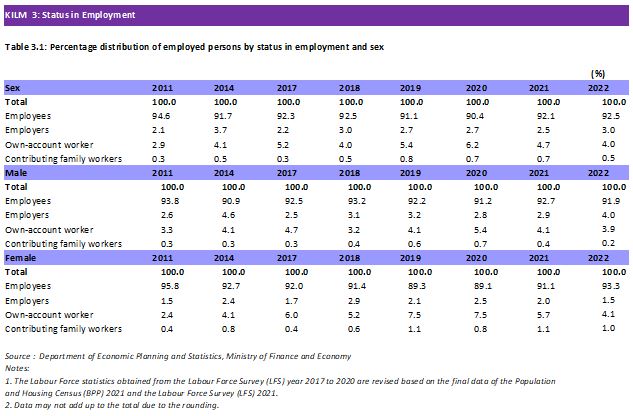
3.1 by Sex, Age, Migratory status, Race, District and Education
Introduction and Background
Status in employment refers to the position of the employed person at his/her place of work with regard to the employment characteristics.
a) Employees:
A person who works in government department, private business enterprises or organisations, including family business, and receives regular pay.
b) Employers:
A person who runs a business on his own or in partnership and engages at least one paid employee on a continuous basis in operating the business.
c) Own account workers:
A person who runs a business on his own or in partnership but does not engage any paid employee.
d) Contributing family workers:
A person who works in his/her family business without receiving any regular pay.