| Back |
| 1.Labour Force Participation Rate |
| 2.Employment to Population Ratio |
| 3.Status in Employment |
| 4.Employment by Sector |
| 5.Employment by Occupation |
| 6.Part-time Workers |
| 7.Hours of Work |
| 8.Employment in Informal Economy |
| 9.Unemployment |
| 10.Youth Unemployment |
| 11.Long-term Unemployment |
| 12.Time-related Underemployment |
| 13.Inactivity |
| 14.Education Attainment and Illiteracy |
| 15.Wages and Compensation Costs |
| 16.Labour Productivity |
| 17.Poverty, Income Distribution, Employment by Economic Class |
| |
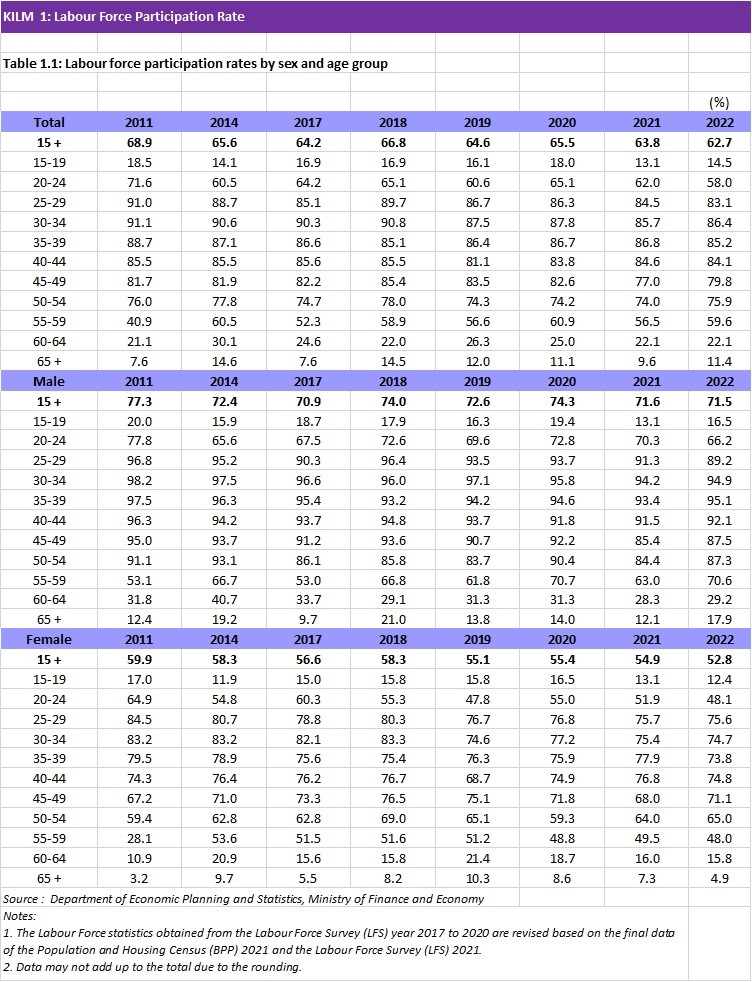
KILM 1: Labour Force Participation Rate
Click here for detailed indicators –>
1.1 by Sex, Age, Migratory status, Race and District
1.2 by Sex, Migratory Status and Education attainment
Introduction and Background
The labour force participation rate (LFPR) is a measure of the proportion of a country’s working-age population that engages actively in the labour market, either by working or looking for work; it provides an indication of the size of the supply of labour available to engage in the production of goods and services, relative to the population at working age.
LFPR is defined as the ratio of the labour force to the working age population (15 years and over), expressed as percentage: