| Back |
| 1.Labour Force Participation Rate |
| 2.Employment to Population Ratio |
| 3.Status in Employment |
| 4.Employment by Sector |
| 5.Employment by Occupation |
| 6.Part-time Workers |
| 7.Hours of Work |
| 8.Employment in Informal Economy |
| 9.Unemployment |
| 10.Youth Unemployment |
| 11.Long-term Unemployment |
| 12.Time-related Underemployment |
| 13.Inactivity |
| 14.Education Attainment and Illiteracy |
| 15.Wages and Compensation Costs |
| 16.Labour Productivity |
| 17.Poverty, Income Distribution, Employment by Economic Class |
KILM 2: Employment to Population Ratio
Click here for detailed indicators –>
2.1 by Sex, Age, Migratory Status, Race and District
2.2 by Sex, Aged. Migratory status and Education attainment
Introduction and Background
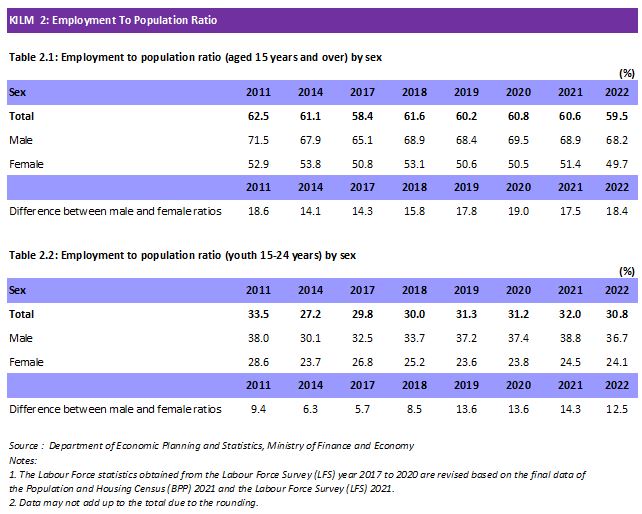
The employment to population ratio is defined as the proportion of a country’s working-age population that is employed. A high ratio means that a large proportion of a country’s population is employed, while a low ratio means that a large share of the population is not involved directly in market-related activities, because they are either unemployed or (more likely) out of the labour force altogether.
Employment-to-population ratio is defined as the employed population to the working age population (15 years and over), expressed as percentage: