| Back |
| 1.Labour Force Participation Rate |
| 2.Employment to Population Ratio |
| 3.Status in Employment |
| 4.Employment by Sector |
| 5.Employment by Occupation |
| 6.Part-time Workers |
| 7.Hours of Work |
| 8.Employment in Informal Economy |
| 9.Unemployment |
| 10.Youth Unemployment |
| 11.Long-term Unemployment |
| 12.Time-related Underemployment |
| 13.Inactivity |
| 14.Education Attainment and Illiteracy |
| 15.Wages and Compensation Costs |
| 16.Labour Productivity |
| 17.Poverty, Income Distribution, Employment by Economic Class |
KILM 13: Persons outside the labour force
Click here for detailed indicators –>
13.1 Discouraged Job-seekers
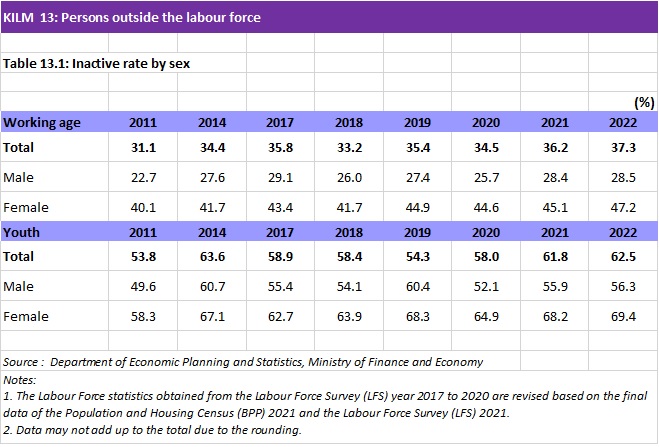
13.2 Inactivity Rate (%)
13.3 Youth not in education, employment or training (NEET) and NEET Rate (%) by Sex
Introduction and Background
The labour force is defined as the sum of the employed and the unemployed. The remainder of the population is the number of persons outside the labour force.
The inactivity rate is defined as the ratio of the population outside the labour force to the working-age population (15 years and over), expressed as percentage: