| Back |
| 1.Labour Force Participation Rate |
| 2.Employment to Population Ratio |
| 3.Status in Employment |
| 4.Employment by Sector |
| 5.Employment by Occupation |
| 6.Part-time Workers |
| 7.Hours of Work |
| 8.Employment in Informal Economy |
| 9.Unemployment |
| 10.Youth Unemployment |
| 11.Long-term Unemployment |
| 12.Time-related Underemployment |
| 13.Inactivity |
| 14.Education Attainment and Illiteracy |
| 15.Wages and Compensation Costs |
| 16.Labour Productivity |
| 17.Poverty, Income Distribution, Employment by Economic Class |
KILM 11: Long-term unemployment
Click here for detailed indicators –>
11.1 by Sex, Age group, Migratory Status, Race and District
11.2 rate (%) by Sex, Age group, Migratory Status, Race and District
11.3 (%) by Sex, Age group, Migratory Status, Race and District
Introduction and Background
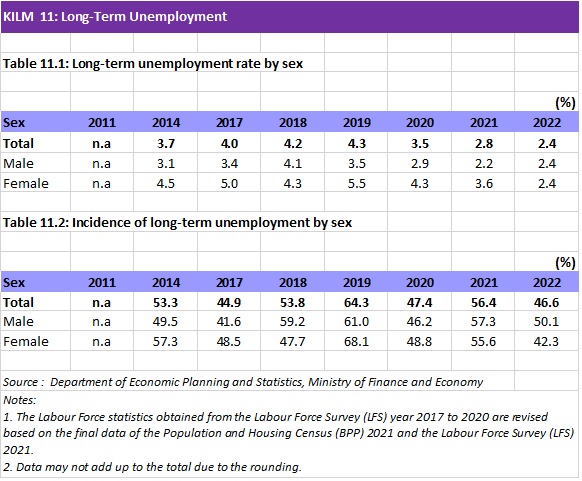
The indicators on long-term unemployment look at duration of unemployment, that is, the length of time that an unemployed person has been without work, available for work and looking for a job. KILM 11 consists of two indicators to evaluate unemployment:
a) long-term unemployment – all persons without job continuously for more than a year (12 months)
b) classify the amount of individuals into different unemployment duration clusters.
The long-term unemployment indicator is further separated into:
a) the long-term unemployment rate – measured as the sum of all those unemployed for longer than a year as a percentage of the labour force
b) the incidence of long-term unemployment – measured as the sum of all those unemployed longer than a year as a percentage of the total unemployed.