| Back |
| 1.Labour Force Participation Rate |
| 2.Employment to Population Ratio |
| 3.Status in Employment |
| 4.Employment by Sector |
| 5.Employment by Occupation |
| 6.Part-time Workers |
| 7.Hours of Work |
| 8.Employment in Informal Economy |
| 9.Unemployment |
| 10.Youth Unemployment |
| 11.Long-term Unemployment |
| 12.Time-related Underemployment |
| 13.Inactivity |
| 14.Education Attainment and Illiteracy |
| 15.Wages and Compensation Costs |
| 16.Labour Productivity |
| 17.Poverty, Income Distribution, Employment by Economic Class |
KILM 8: Employment in the informal economy
Click here for detailed indicators –>
8.1 Employment in the informal economy and its components as percentage of non-agricultural employment
Introduction and Background
Summary of formal/informal employment in formal/informal sector
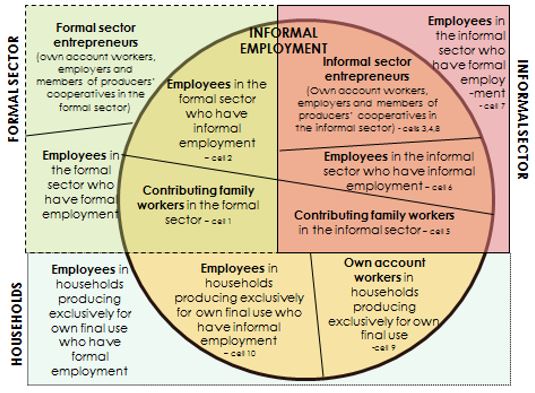
The KILM 8 indicator is a measure of employment in the informal sector as a percentage of total non-agricultural employment.
a) Formal sector:
Formal sector is an enterprise/business that is officially registered and kept a record of book of accounts (assets and expenditures).
Examples: People working in civil service, government service, etc
b) Informal sector:
Informal sector is an enterprise/business that is not officially registered and do not kept a record of book of accounts (assets and expenditures).
Example: online unregistered business.
c)Formal employment:
Formal employment are the people who work to receive a regular wage and assured certain rights Example: paid annual leave, paid sick leave.
d) Informal employment:
Informal employment refers to jobs as observation units as opposed to the concept of informal sector that refers to production units as observation units. It is broader concept including:
i) employment in the informal sector (except those rare employees in the sector who may have formal employment), and
ii) informal employment outside the informal sector